The Private Land Stewardship Academy is designed to guide students, landowners, managers, and natural resources professionals through the foundational book, The Art & Science of Private Land Stewardship, which is in press. Each section of the book is developed as a module that includes author introductions, live panel discussions, and optional field workshops to complement the curriculum's virtual components, allowing partners to customize experiences to their local or regional needs.
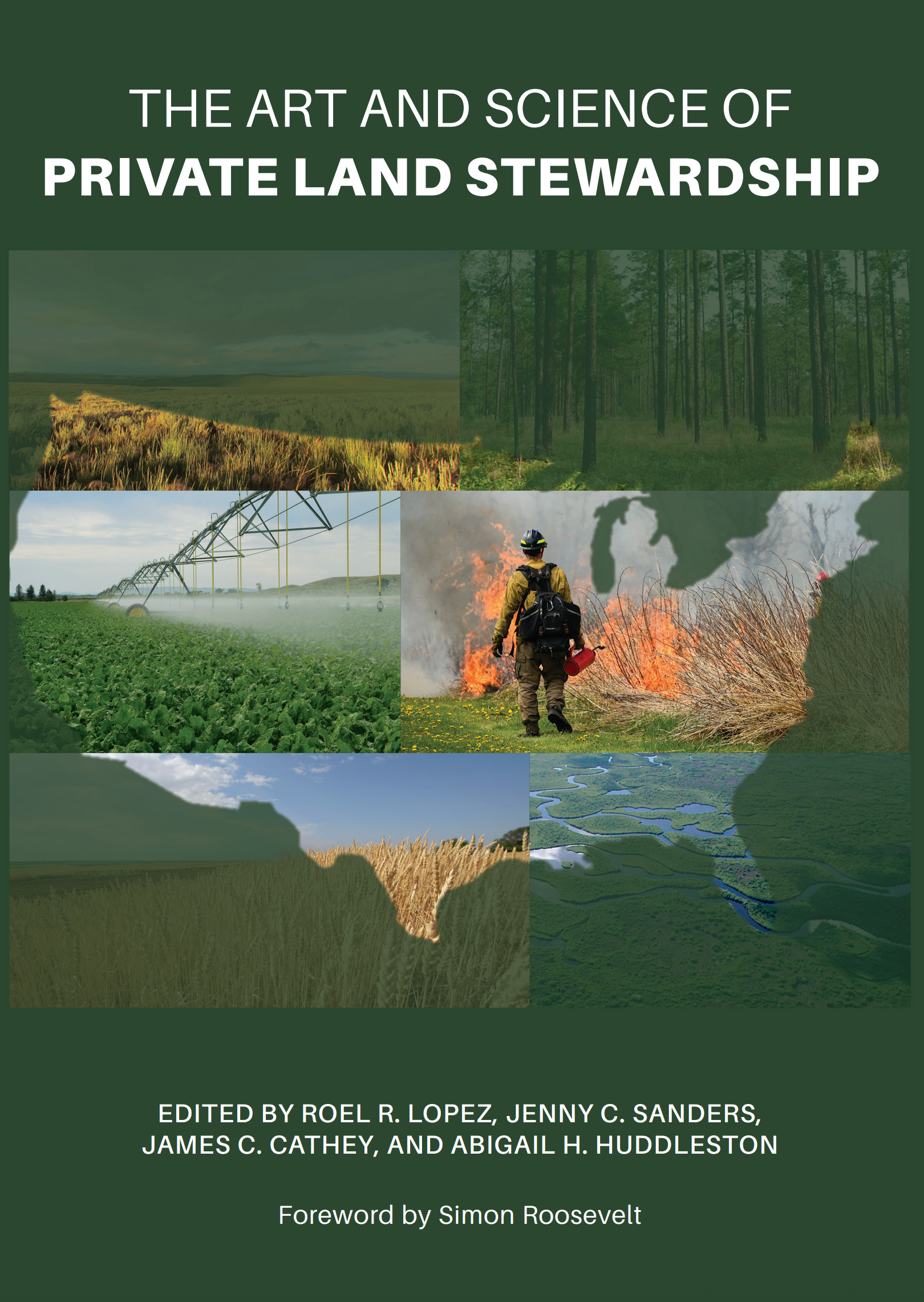
Cover image of The Art and Science of Private Land Stewardship
The Preface
Private working lands (family farms, ranches, and forests) account for 70% (more than one billion acres) of U.S. land. These lands provide food, fiber, wildlife habitat, recreational opportunities, and economic support to rural communities. Working lands filter the water we drink, purify the air we breathe, and provide cultural and societal benefits. The U.S. Fish and Wildlife Service, for example, often recognizes and acknowledges that the health and sustainability of fish and wildlife populations is in the hands of private landowners.
The critical role that private land stewards play in ensuring the management and sustainability of our nation's natural resources cannot be overstated. Their job is often thankless, and their contributions to society are often unknown and unappreciated. Despite this, the individuals who work the land do so for the benefit of us all. Driven by an innate and often spiritual connection to the land upon which their business depends, no one has a more profound vested interest in the health and sustainability of our natural resources than private land stewards.
"When land does well for its owner, and the owner does well by his land; when both end up better because of their partnership, we have conservation. When one or the other grows poorer, we do not." - Aldo Leopold
State and federal natural resource agencies devote significant resources to programs and initiatives to support private land conservation and management. For generations, these agencies and programs have been administered by professionals who grew up on farms and ranches themselves, and therefore had an inherent understanding of the landowners they were charged with supporting.
However, a shift has occurred, and research suggests that up to 70% of recent graduates of agriculture and natural resource university programs have little to no background on private lands.
While they have been trained in biology and ecology, they have little understanding of the motivations and character of private landowners, and even less understanding of the day-to-day challenges of working the land. As our population becomes increasingly disconnected from the outdoors, sharing and understanding the values and motivations of private landowners is needed to offer perspective to today's natural resource professionals. Truly, this conduit is imperative to the management and sustainability of rural lands.
The Art and Science of Private Land Stewardship seeks to explore the history, philosophy, practice. and use of science-based information to provide perspective to natural resource professionals. conservation advocates, federal, state, and local decision-makers, and the general public in their work to support the working lands that sustain our country. Understanding the character of private land stewards is essential to creating programs and partnerships that will effectively support the resilience and sustainability of our working lands, and thereby natural resources, into the future.
— Editors Roel Lopez, Jenny Sanders, Jim Cathey & Abigail Huddleston
Book Chapters and Authors
Edited by Roel Lopez, Jenny Sanders, Jim Cathey & Abigail Huddleston
Foreword – Simon Roosevelt
Section I: Concepts and Origins of Land Stewardship and Private Lands
Chapter 1: Private Lands – Origins – Neal Wilkins
Chapter 2: Land Stewardship – A Concept – Neal Wilkins
Chapter 3: Public Benefits of Private Lands – Chad Ellis, Jeff Goodwin, and Myriah Johnson
Section II: Trends and Status of Private Lands
Chapter 4: Land in the United States – National Overview - Addie Smith, Matthew Crawford, Kevin Skow, Garrett Powers, Alison Lund, and Roel Lopez
Chapter 5: Land Status and Trends – Regional Overview - Addie Smith, Matthew Crawford, Kevin Skow, Garrett Powers, Alison Lund, and Roel Lopez
Section III: Trends and Status of Private Landowners
Chapter 6: General Demographics – Angelica Lopez, Daniela Barrientos, Tony Mayoral, and Roel Lopez
Chapter 7: Values and Attitudes – Jenny Sanders and Roel Lopez
Chapter 8: Common Motivations – Israel Parker, Andrea Feldpausch-Parker, and Nils Peterson
Section IV: The Practice of Stewardship
Chapter 9: Approaches and Tools – Jim Cathey, Abigail Holmes Huddleston, and Bruce Beard
Chapter 10: The Nexus of Public Lands in a Private Landscape – Bruce Beard, R. Tom Darden, Buddy Huffaker, Mark Madison, Abigail Holmes Huddleston, and Andrea Montalvo
Chapter 11: Legal and Regulatory Challenges – Temple Stoellinger, Jim Bradbury, and Karrigan Bork
Chapter 12: Economic Challenges and Opportunities – Drew Bennett and Clay Mathis
Section V: Fostering the Stewardship Pathway
Chapter 13: Land Stewardship – Agency Perspective – Wendell Gilgert and Ken Cearley
Chapter 14: Land Stewardship – Professional Manager Perspective – Blake Murden, Ty Bartoskewitz, and Decky Spiller
Chapter 15: Land Stewardship – Landowner Perspective – Landowner Testimonials
Chapter 16: Spiritual Responsibility of Stewardship – Gene Miller, Matt Wagner, and Oswald John Nira
Chapter 17: Development of a Land Ethic – Steve Nelle
Lopez, R. L., Sanders, J. R., Cathey, J. C., Huddleston, A. H. (Eds.). (in press). The Art & Science of Private Land Stewardship. Texas A&M University Press.